
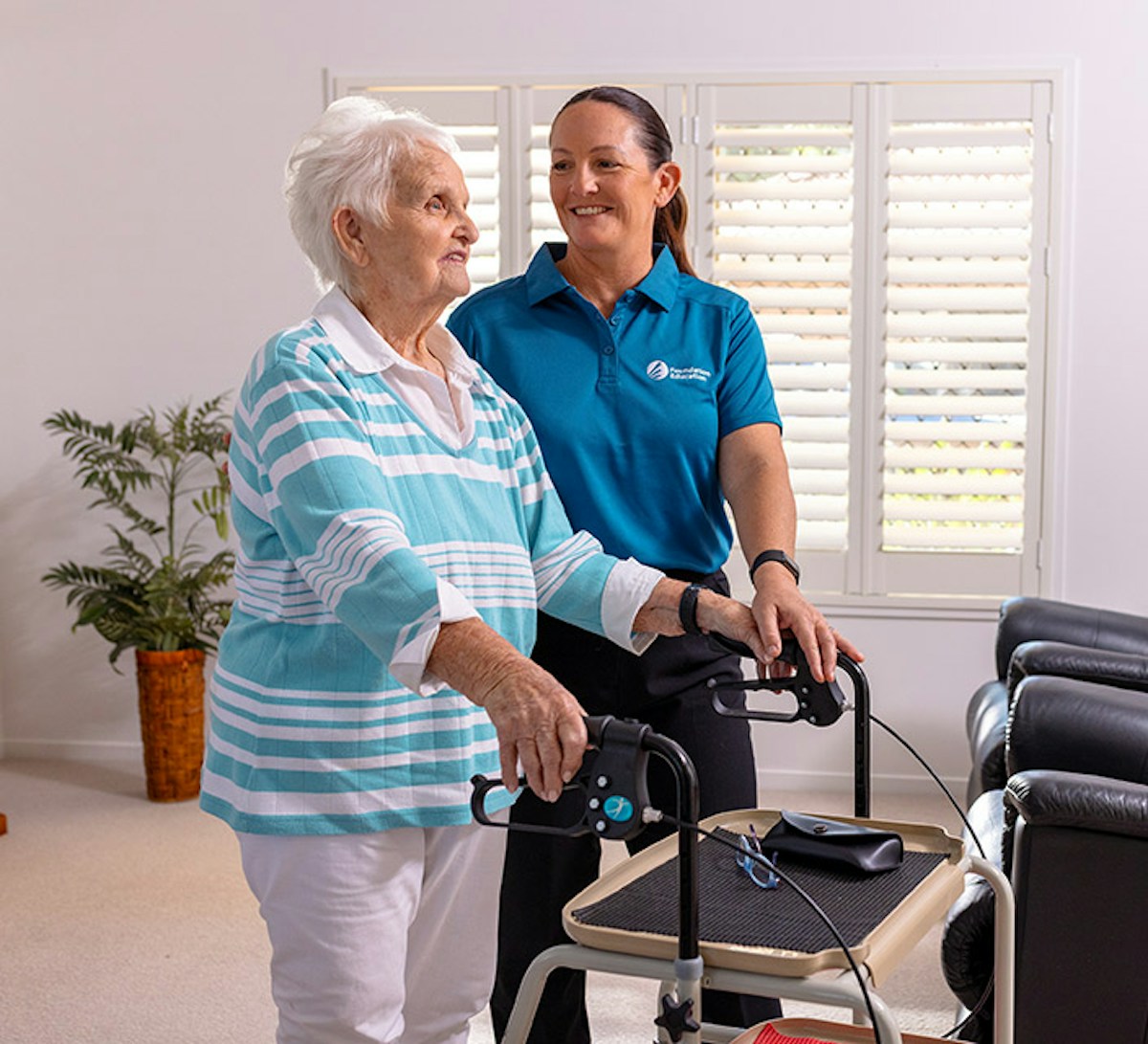
Foundation Education support worker assisting an elderly woman using a mobility walker inside a home.

CHC33021

Certificate III in Individual Support (Ageing and Disability)

Make every moment matter with a career in care.

Pay Upfront and Save up to $900* on selected coursesPay Upfront and Save up to $900* on selected courses

Make every moment matter with a career in Individual Support.

Is caring for others your calling? Support workers play an important role in helping people stay independent, connected and confident in their daily lives. Beyond providing practical assistance, they can help people maintain their independence, participate in their communities and continue doing the things that matter to them.

The CHC33021 Certificate III in Individual Support (Ageing and Disability) can help you prepare for a rewarding career supporting older Australians and people living with disability. Combining flexible online theory with practical placement, you'll build the skills and knowledge to provide person-centred support across aged care, disability, home and community care settings.

What is CHC33021 Certificate III in Individual Support?

The CHC33021 Certificate III in Individual Support (Ageing and Disability) is a nationally recognised, entry-level qualification designed to prepare you for support roles across the care sector. Combining ageing and disability specialisations, you'll learn how to provide individualised support that promotes independence, wellbeing and dignity. This gives you the flexibility to explore career opportunities across aged care and disability support, rather than focusing on one care setting.

Build skills for a growing care sector

Looking for a career where your work can make a meaningful difference? Australia's demand for care workers continues to grow, with research forecasting a shortfall of at least 110,000 direct-care workers by 2030 (Committee for Economic Development of Australia). With the CHC33021 Certificate III in Individual Support (Ageing and Disability), you'll develop skills relevant to roles such as Aged Care Worker, Personal Care Assistant and Disability Support Worker.

  • Explore different care settings: Build skills relevant to aged care, disability support, home care and community care.

  • Develop specialised skills: Learn about areas including dementia care, palliative care and social inclusion.

  • Build your career foundation: Prepare for entry-level opportunities and further development across the care sector.

Study with Foundation Education

Build your skills around work, family and other commitments. Complete the theoretical components of your course online, alongside 120 hours of mandatory practical placement where you'll put your learning into practice in a real care environment. You'll be supported as you develop practical, industry-relevant skills and work towards a nationally recognised qualification.

Course snapshot
Qualification

Certificate III in Individual Support (Ageing and Disability)

Delivery structure

Theoretical Elements: 

Study the theoretical elements of this course, anywhere and anytime through our online learning platform. 

Practical Elements: 

You’ll be required to complete a minimum of 120 hours of mandatory work placement in a workplace that must provide opportunities for the student to demonstrate the skills required in a direct support workplace. Students must perform tasks under the direction of a qualified workplace supervisor.

Duration

Up to 12 months

Study load
  • 120  hours of mandatory work placement.
  • 15 course units to complete.*
  • Complete 1 course unit approximately every 3.5 weeks to graduate in 12 months.
Nationally Recognised Training Logo
Aged care support worker providing care and reassurance to an older person.

Career outcomes in Ageing and Disability Support

Want a career centred around helping people live with greater independence, dignity and connection? The CHC33021 Certificate III in Individual Support (Ageing and Disability) can help prepare you for a variety of entry-level roles across aged care and disability support.

Aged Care Worker

As Australia's ageing population continues to grow, demand for qualified aged care workers remains strong across residential and community-based settings. Support older Australians with everyday activities while helping them maintain their independence, wellbeing and quality of life. Depending on your role and workplace, you may assist with personal care, mobility, daily living activities, social engagement and emotional wellbeing.

Potential roles may include:

●        Aged Care Worker

●        Personal Care Assistant

●        Residential Care Worker

Disability Support Worker

Help people living with disability work towards their individual goals, participate in their communities and live with greater independence. Your role may involve supporting daily activities, community participation, life skills and social inclusion.

Potential roles may include:

●        Disability Support Worker

●        Disability Support Assistant

●        Community Support Worker

Home Care Worker

Help people continue living independently in their own homes by providing practical, person-centred support. Depending on the role, this could include assistance with personal care, household tasks, meal preparation, mobility and social connection.

Community Care Worker

Help people stay active, connected and involved in their communities. You may support clients to access services, attend appointments, participate in activities and maintain important social and community connections.

Explore career pathways in Individual Support with Foundation EducationCareer Pathways - Individual Support Course Page

Course information and requirements

Explore the course requirements, assessments, work placement, resources and other important information you'll need to complete this qualification.

Education
There are no formal entry requirements in this qualification.

Pre-screening
The completion of a Pre-screening Activity will be conducted for all potential students prior to their enrolment in any training for this targeted cohort. The purpose of this initial activity is to allow the potential student to demonstrate indications of suitability for their selected course and to capture evidence of suitability. It will also assist in the determination of Language Literacy and Numeracy levels and including Digital literacy levels. The activity may include but is not limited to integrated questions to demonstrate alignment with course objectives and requirements, work expectations and work placement performance. The function of this activity is to ensure positive student outcomes.

Parental permission
If you are under 18 your enrolment form will need to be signed by a parent or guardian.

Residency status
To enrol, you will need to be a permanent Australian resident (or equivalent) or have the right to study in Australia other than a Student Visa.

Physical capabilities
You’ll be required to complete workplace tasks that involve manual handling and may be required to have certain vaccinations or a medical exemption if requested.

Recognition of prior learning
If you can demonstrate competency in some units, the recognition of prior learning (RPL) assessment process may be available to recognise the skills and knowledge you may have gained through formal and informal training and/or learning, work experience and life experience

Assessments will include knowledge questions, workplace observation and simulated observation.

Knowledge questions: You’ll be presented with short answer questions that require a written response. 

Quiz: You’ll be presented with quizzes that include multiple choice, matching, and true or false questions to test your knowledge. 

Workplace observation assessment: You’ll be required to complete set tasks with the nominated workplace supervisor, as per the Placement Agreement. This also includes the completion of task documents, templates, and client feedback which the student must complete in conjunction with
observation tasks.

Simulated Observation Assessment: You’ll be required to simulate performing set tasks with their nominated workplace supervisor. This also includes the completion of task documents, templates, and simulated client feedback, which the student must complete in conjunction with observation tasks.

Work placement requirements
This qualification requires you to complete 120 hours of mandatory work placement in a suitable workplace under the supervision of a qualified workplace supervisor.
You will be required to secure a suitable placement. Depending on your circumstances, placement can be completed in one of the following ways.
  • Student-arranged placement: Students are required to organise their own placement in a suitable workplace. All student-arranged placements must be approved by Foundation Education before placement starts to ensure the workplace, supervisor, and duties meet the course requirements. A placement agreement must be completed prior to commencement.
  • Placement in your current workplace: If you are currently employed in a relevant role within the care or support sector, you may be able to complete your placement in your existing workplace, provided the environment and supervision meet course requirements. A placement agreement must be completed prior to commencement.

Workplace supervisor requirements

Students must perform tasks under the direction of a qualified supervisor, as per the performance
requirements for each unit of competency. The supervisor must meet the criteria:

Option 1: Minimum of a Cert III in Individual Support Qualification or a Related Qualification in Community Services or Health Services; and/or

Option 2: 3 years working in the industry in one of the below positions:

  • Personal Care Assistant
  • Personal Care Worker
  • Nursing Assistant
  • Aged Care Worker
  • Disability Support Worker

Work placement logbook

Record of service periods/shifts completed by students performing real and simulated tasks in workplace environments. This assessment must be completed in a pre-approved real workplace setting under the direct supervision of a suitably qualified, pre-approved workplace supervisor or supervisors.
The logbook must be submitted via our online learning management platform

Additional requirements

  • NDIS Screening check: All students must complete NDIS screening. For students that meet workplace requirements without having to undertake an NDIS screening check, alternative
    work placement requirements can be made on a case-by-case basis. (Please note: Placement requirements, such as NDIS checks, can take time to process depending on the relevant state
    or territory authority. We recommend beginning preparations for placement several months in advance to avoid delays.)
  • Some placement providers may have additional requirements such as immunisation

To successfully complete this course, it’s essential that your placement provider has the necessary equipment, resources and/or documentation. For detailed information on these requirements, please reach out to our friendly Career Advisors to obtain a copy of the complete list.

For the online part of this course, you’ll need regular access to:

  • Computer: Laptop or desktop computer with working speakers or headphone points. Note that our Learning Management System (LMS) is not compatible with touchscreen
  • Internet: High-speed internet such as Broadband or ADSL, T1/T2, fiber optic (Dial up access is not recommended)
  • Windows: Operating system – Windows 8 or above MAC: Operating system - OS X 10.14 Mojave or later
  • Internet browser: Google Chrome and Firefox are recommended browsers and have Javascript enabled. Browsers like Edge, Safari and out-of-date browsers may cause issues with some material, particularly our interactive elements in the LMS
  • Software: Flash, Adobe Reader, Microsoft Word (or Open Office which is free to download)
  • Office equipment: A printer and scanner may be required to print and upload some of your assessments
  • Mobile phone with video capability or video camera: Some assessments in your course may require you to take and submit videos of you undertaking tasks for assessment.

Why choose Foundation Education?

When you’re preparing for a career that makes a difference, where you study matters too. Discover why students choose Foundation Education to build the skills and knowledge for a future in aged care and disability support.

Flexible Icon

Flexible online learning

Complete your theoretical coursework through our online learning platform and fit your studies around your other commitments.

Industry Icon

Practical, industry-relevant training

Build knowledge through your theoretical studies and put your skills into practice through mandatory work placement.

National Icon

Nationally recognised training

Work towards the nationally recognised CHC33021 Certificate III in Individual Support (Ageing and Disability), valued by Australian employers.

Trainer Icon

Experienced Trainers and Assessors

Learn with guidance and support from experienced, Australian-based Trainers and Assessors throughout your course.

Personal Icon

Personalised course advice

Our Careers Advisors can help you understand the course, entry requirements, study expectations and enrolment process before you get started.

Learning Icon

Dedicated student support

Access support throughout your studies, from enrolment through to course completion.

Support Icon

Learning support services

Additional learning support may be available depending on your individual needs, including support plans and alternative-format learning resources.

Payment Icon

Flexible payment options

Choose from a range of available payment options to help you manage the cost of your course.

Units

The CHC33021 Certificate III in Individual Support (Ageing and Disability) consists of nationally recognised units that equip you with the practical skills and knowledge required to provide person-centred care across aged care, disability support, home care and community care settings.

CHC33021 Certificate III in Individual Support

This unit describes the performance outcomes, skills and knowledge required to organise, provide and monitor personal support services for a person within the limits established by an individualised plan. The individualised plan refers to the support or service provision plan developed for the person accessing the service and may have different names in different organisations.

This unit applies to workers who provide care or support under direct, indirect or remote supervision. Work is carried out in a manner which supports independence as well as the physical and emotional wellbeing of the person receiving support.

This unit describes the performance outcomes, skills and knowledge required to facilitate the empowerment of people receiving support, and to deliver rights-based services using a person-centred approach. It should be carried out in conjunction with individualised plans.

This unit applies to workers in varied care and support contexts.

The skills in this unit must be applied in accordance with Commonwealth and State/Territory legislation, Australian standards and industry codes of practice.

This unit describes the skills and knowledge required to provide individualised services in ways that support independence, as well as physical and emotional wellbeing.

This unit applies to workers in a range of community services contexts who provide frontline support services within the context of an established individualised plan.

This unit describes the performance outcomes, skills and knowledge required to work with basic information about healthy body systems and the impacts of ageing and disability. It includes recognising and reporting any changes in healthy bodies involving people who are ageing or living with disability. Any identified issues of concern to be reported to the supervisor or professional health staff.

This unit applies to workers across a range of community services contexts.

This unit describes the skills and knowledge required to communicate effectively with clients, colleagues, management and other industry providers. This unit applies to a range of health and community service contexts where workers may communicate face-to-face, in writing or using digital media and work with limited responsibility under direct or indirect supervision.

This unit describes the skills and knowledge required to work respectfully with people from diverse social and cultural groups and situations, including Aboriginal and/or Torres Strait Islander people. This unit applies to all workers.

This unit describes the skills and knowledge required to identify and work within the legal and ethical frameworks that apply to an individual job role.

This unit applies to community services and health workers who play a proactive role in identifying and meeting their legal and ethical responsibilities. 

This unit describes the skills and knowledge required to follow organisational infection prevention and control procedures, including implementing standard and transmission-based precautions and responding to infection risks. This unit applies to individuals working in health and direct client care contexts.

This unit describes the skills and knowledge required for a worker to participate in safe work practices to ensure their own health and safety, and that of others in work environments that involve caring directly for clients. It has a focus on maintaining safety of the worker, the people being supported and other community members. This unit applies to all workers who require knowledge of workplace health and safety (WHS) to carry out their own work, in both centre-based and home-based service provision.

This unit describes the performance outcomes, skills and knowledge required to provide person-centred care and support to people living with dementia. It involves following an established individualised plan.

This unit applies to workers in a residential or community context, including family homes. Work performed requires some discretion and judgement and may be carried out under direct, indirect or remote supervision.

This unit describes the performance outcomes, skills and knowledge required to work effectively in an aged care work context. The unit covers meeting job requirements, complying with organisational requirements and working in an aged care sector context.

This unit applies to individuals who work with older people in a range of community services and health contexts. Work performed requires some discretion and judgement and is carried out under regular direct, indirect or remote supervision.

This unit describes the performance outcomes, skills and knowledge required to provide care for people with life-limiting illness and those within the normal ageing process using a palliative approach, as well as end-of-life care.

This unit applies to workers in a residential or community context. Work performed requires some discretion and judgement and is carried out under regular direct, indirect or remote supervision.

This unit describes the performance outcomes, skills and knowledge required to assist with supporting the ongoing skill development of a person with disability. It involves following and contributing to an established individualised plan and using a positive, strengths-based approach.

This unit applies to individuals who work with people with disability in a range of community services and health contexts. Work performed requires some discretion and judgement and may be carried out under regular direct or indirect supervision.

This unit describes the performance outcomes, skills and knowledge required to assist with supporting people with disability in community participation and social inclusion using a person-centred approach. This involves enabling people to make choices to maximise their participation in various community settings, functions and activities to enhance psychosocial wellbeing and lifestyle in accordance with the person’s needs and preferences.

This unit applies to workers in varied disability services contexts. Work performed requires some discretion and judgement and may be carried out under regular direct, indirect or remote supervision.

This unit describes the performance outcomes, skills and knowledge required to work effectively in a disability support work context. The unit covers meeting job requirements, complying with organisational requirements and working in a disability sector context.

This unit applies to individuals who work with people with disability in a range of community services and health contexts. Work performed requires some discretion and judgement and will be carried out under regular direct or indirect supervision.

Cost and payment

To make studying more accessible, you can choose to pay your course fees upfront by credit card or bank transfer, or spread the cost with a flexible payment plan. For current course fees and available payment options, enquire now to speak with a Careers Advisor.

Your course fee includes

Graduation Hat Icon

Delivery and assessment of your qualification

Book Icon

Study materials (including all resources)

Speech Bubble Icon

Ongoing support from our Education Team

We offer two payment methods

Piggy Bank Icon

Full fee upfront

Payment Icon

Instalment plans

For more information about the course costs, please call us on 1300 616 197.

Frequently Asked Questions

The CHC33021 Certificate III in Individual Support (Ageing and Disability) equips you with nationally recognised skills to provide quality care for ageing individuals and people with disabilities. You’ll gain both practical and theoretical knowledge to start or grow your career in Australia’s care sector.

Yes, the CHC33021 Certificate III in Individual Support (Ageing and Disability) includes training relevant to both sectors. This can broaden your employment opportunities and allow you to work across a variety of care settings.

There is no single pathway into the care sector. Some students are entering the workforce for the first time. Others are changing careers in search of more meaningful work. Many have spent time caring for a family member or loved one and want to build on that experience professionally.

If you've ever enjoyed helping others, supporting people through challenges or making a positive difference in someone's day, this course could be worth considering. Many students are inspired by their own caring experiences.

  • Career Changer: Transition from retail, hospitality, or admin into a care career.

  • Parent or Carer: Seek meaningful, flexible work as a Home Care Worker.

  • Existing Care Worker: Formalise your skills with a nationally recognised qualification.

  • Skills Gained: Master person-centred care, dementia support, and community participation.

  • Industry Recognition: Secure roles in aged care facilities or disability services.

Theoretical study is completed online at your own pace, with a mix of interactive learning, practical assessments, and a mandatory work placement to help you build hands-on skills for real-world care settings.

We offer flexible payment plans to suit your budget, including upfront payments or manageable weekly or fortnightly instalments.

Graduates may pursue roles such as Aged Care Worker, Disability Support Worker, Personal Care Assistant, Community Care Worker, and Home Care Support Worker. Opportunities may be available across residential aged care facilities, disability support providers and community care organisations.

No course can guarantee employment, and we'd rather be upfront about that. What a recognised qualification does is show employers you have the specific skills and knowledge the care sector relies on. How quickly you're hired will still depend on your location, the facilities and providers near you, and the local job market.

You may also be interested in

HLT33021

Certificate III in Allied Health Assistance

Work under the direction of allied health professionals to support patient programs and therapeutic activities in a range of areas with the Certificate III in Allied Health Assistance.

HLT43021

Certificate IV in Allied Health Assistance

Support Allied Health professionals to improve the wellbeing of patients in a variety of Allied Health settings.

HLT43021

Certificate IV in Allied Health Assistance - Physiotherapy and Occupational Therapy Focus

Create your future as an Allied Health Assistant supporting Physiotherapists or Occupational Therapists improve the well-being of patients.